SolarEdge Home Battery 48V Review UK: Specs, Price & Verdict
Written and reviewed by Sepehr. See our editorial policy.
The SolarEdge Home Battery 48V is a modular 4.6kWh lithium iron phosphate (LFP) battery that only makes sense if your solar system already runs on SolarEdge. It is DC-coupled, plugs into SolarEdge's Home Hub or Wave inverters, and stacks up to five modules for about 23kWh. This review works through SolarEdge's own datasheet, this site's pricing, and the question that decides most purchases: is the integration worth paying a premium over a generic low-voltage battery?
SolarEdge Home Battery 48V specs
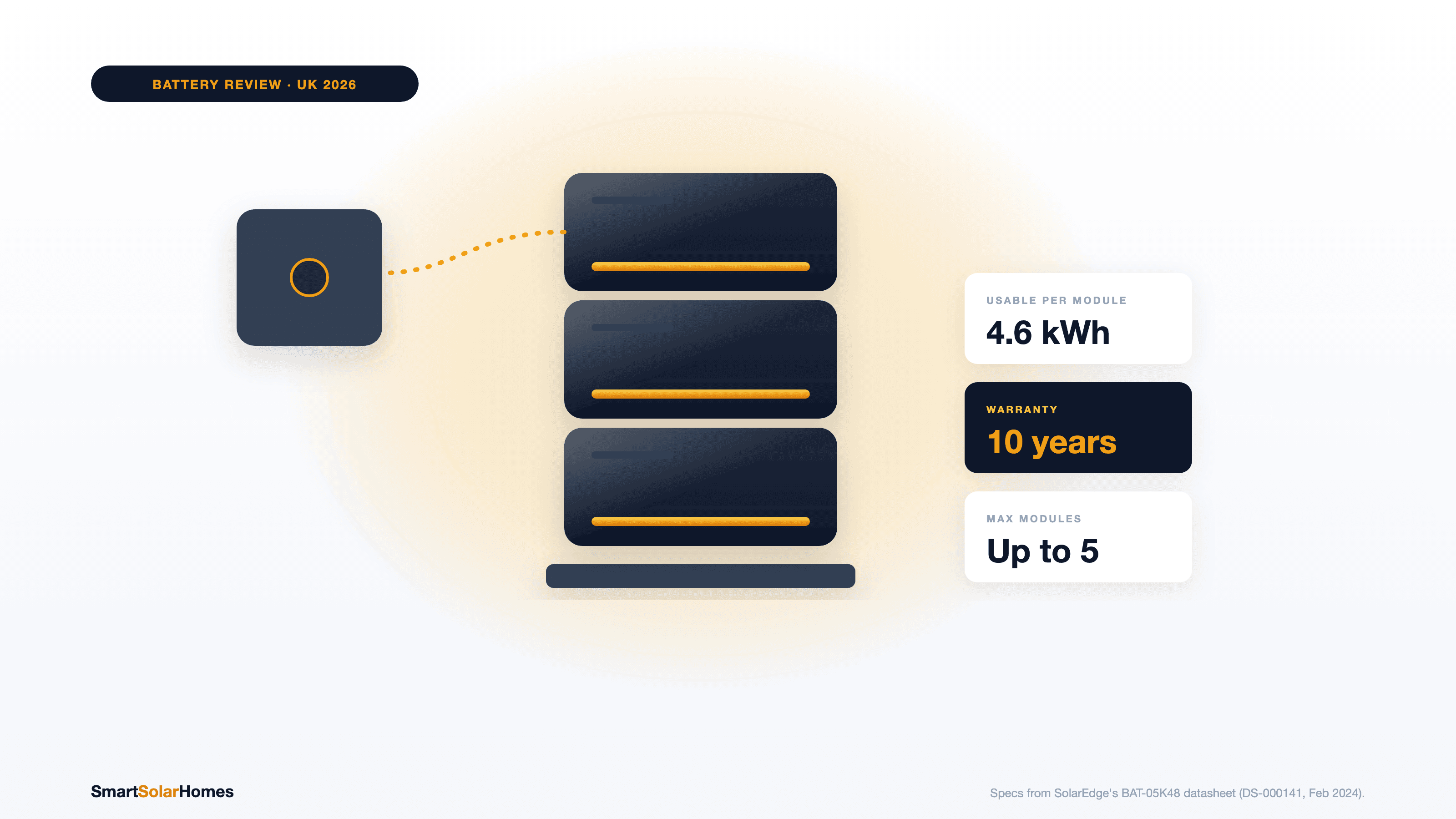
Each module stores 4,600Wh usable at 100% depth of discharge, with a 10-year warranty. Figures below are from SolarEdge's BAT-05K48 datasheet (DS-000141, February 2024).
- Chemistry: lithium iron phosphate (LFP), DC-coupled to the inverter
- Usable energy: 4,600Wh per module; up to 5 modules per inverter (SolarEdge quotes up to 23kWh)
- Continuous power: 2,825W charge and 4,096W discharge for a single module; 5,000W each way with several modules
- Peak cycle efficiency: above 95.4%
- Voltage range: 44.8–56.5Vdc
- Size and weight: 540 × 500 × 240mm (W × H × D, as listed) and 54.7kg per module
- Protection: IP65 / NEMA 3R, rated for indoor and outdoor use; natural convection cooling; under 25dBA at 1 metre
- Operating temperature: −10 to +50°C
- Safety standards listed: IEC 62619, UN38.3 and UL9540A at cell level
Two details matter in practice. First, one module cannot deliver the full 5kW: a single 4.6kWh module is limited to 2,825W charging, so a one-module system will charge slowly. Second, the stack is tall. SolarEdge lists three modules with a top cover at 1,620mm without the floor stand and 1,670mm with it, so check ceiling and wall space. Our battery sizing guide explains how many modules a typical home needs.
One discrepancy to check: a European retailer, ESTG, states that usable capacity per module rose to 4.85kWh from January 2025. SolarEdge's February 2024 datasheet and this site's listing both say 4.6kWh, so ask your installer which version they are supplying.
Which inverters it works with
The 48V battery is built for SolarEdge's Home Hub and Wave inverters, and it will not pair with another brand's hybrid inverter. The datasheet describes the product as optimised for the three-phase Home Hub and Wave range and lists separate cable kits for Home Hub and StorEdge inverters. SolarEdge points buyers to a compatibility matrix for the exact pairings, so confirm your specific inverter model, and whether your supply is single or three-phase, before signing a quote. Our SolarEdge inverter review covers the inverter range, and the hybrid inverter buyer guide explains how battery compatibility works more generally.
Because the battery is DC-coupled, solar power reaches it without an extra AC conversion, which is why SolarEdge quotes a peak cycle efficiency above 95.4%. Everything is managed in one app, covering solar, storage and EV charging, with backup power available on eligible residential installs subject to local rules and, SolarEdge notes, possible firmware updates and extra components.
Price in the UK
This site's product listing prices one 4.6kWh module at £2,373 ex VAT, or roughly £516 per usable kWh (our calculation). Installation is extra, and the datasheet shows several parts sold separately: the top cover (one per tower), the battery-to-inverter cable kit, battery-to-battery cables, tower-to-tower cables and an optional floor stand. Residential batteries installed in Great Britain are currently zero-rated for VAT until 31 March 2027, with the rate reverting to 5% from 1 April 2027 (VAT Notice 708/6), so ask for installed quotes rather than comparing ex-VAT part prices.
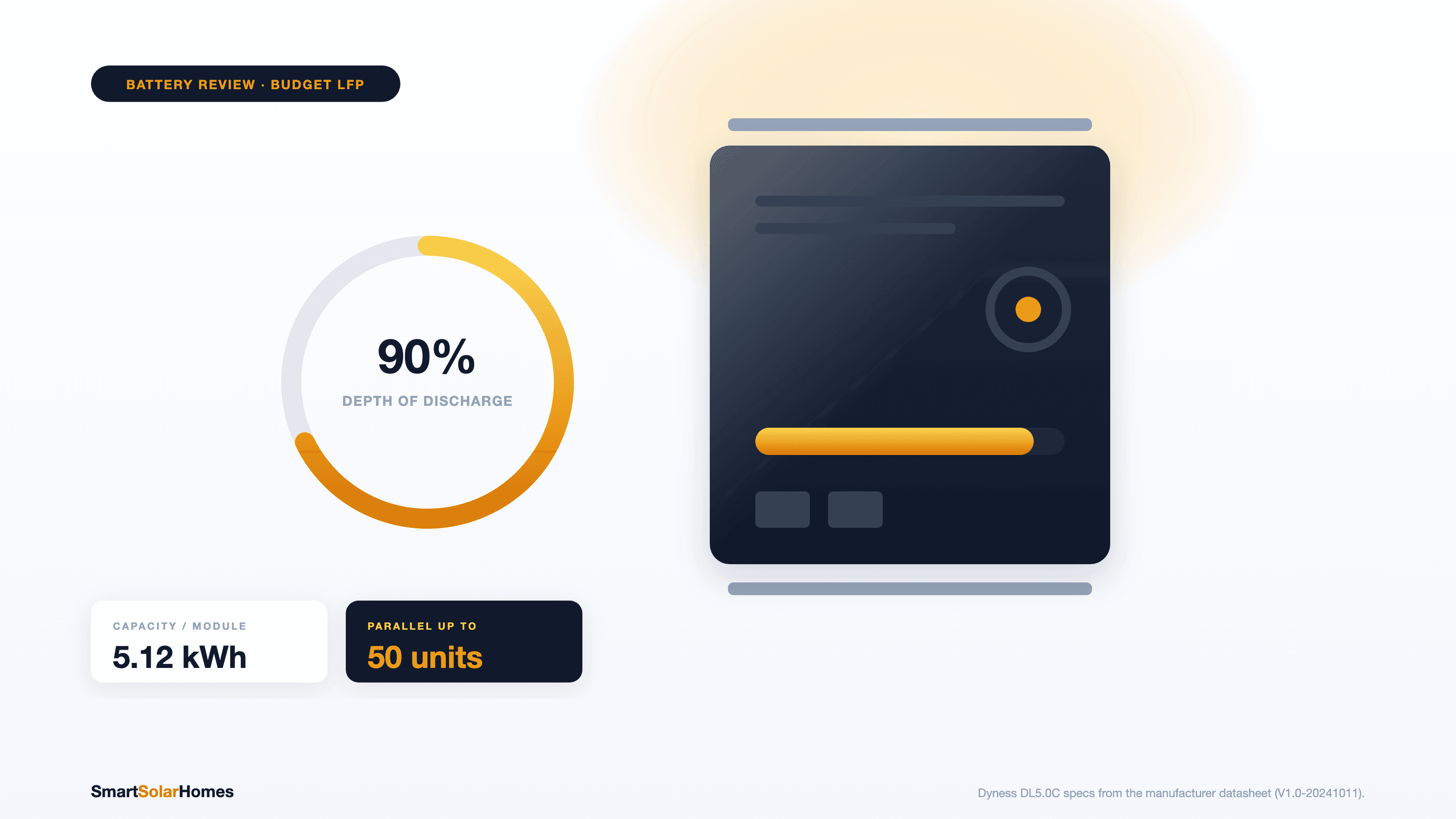
For comparison, this site lists the Dyness DL5.0C at £650 ex VAT for a module of similar usable size, and the Pylontech US5000 is another low-voltage option. The SolarEdge costs several times more per kWh. That gap is the integration premium, and it only pays off if you keep the SolarEdge ecosystem. Our home battery installation guide covers typical installed costs.
Warranty and cold weather
SolarEdge gives a 10-year warranty on the module and refers buyers to its separate limited warranty document for the terms. Read that document: the datasheet warns that running the battery at extreme temperatures for long periods can void warranty cover. It also notes power derating: discharge power falls once the battery's internal temperature passes 40°C, and charge power falls below 15°C, with an internal warm-up routine that uses part of the charge power. For an unheated garage or an exposed outdoor wall, that is worth discussing with your installer. Because SolarEdge supplies the inverter, optimisers and battery, you also get a single warranty provider rather than a split between brands.
Who the SolarEdge Home Battery suits
It suits homes that already have a SolarEdge system, or shaded and complex roofs where panel-level optimisers are the reason you chose SolarEdge in the first place. The one-vendor support and single app are the real benefits. It is a weaker fit if you want the cheapest cost per kWh, want to choose your inverter separately, or have a single-phase supply and cannot get written confirmation of compatibility. If you are comparing premium all-in-one options instead, see our Tesla Powerwall 3 review and the best home batteries roundup. Whichever you choose, get at least two quotes from MCS-certified installers and ask each for the module version, accessories list and warranty terms in writing.
FAQs
How much usable capacity does the SolarEdge Home Battery 48V have?
How many SolarEdge Home Battery modules can you connect?
What warranty does the SolarEdge Home Battery 48V have?
Can I use the SolarEdge Home Battery with a non-SolarEdge inverter?
Is the SolarEdge Home Battery 48V suitable for outdoor installation?
Sources — verified 3 November 2026
- SolarEdge, “SolarEdge Home Battery 48V for Europe, BAT-05K48 datasheet (DS-000141, Feb 2024)” — vpsolar.com
- ESTG, “SolarEdge Home Battery 48V low voltage 4.6kWh pack (BAT-05K48M0B-02)” — www.estg.eu
- GOV.UK, “VAT on energy-saving materials and heating equipment (VAT Notice 708/6)” — www.gov.uk

About the author
Sepehr
Solar specialist & co-founder, Smart Solar Homes
Solar specialist and co-founder of Smart Solar Homes, which works with MCS-certified UK installer partners. I write all the guides and reviews here; the aim is straight-talking education the industry rarely provides.
Citing this page? Please use a dofollow link back to the original article — it helps us keep the data on this page accurate and up to date.
Browse Battery Storage on Smart Solar Homes


Want to compare these side by side? Use the compare tool →
Or browse all Battery Storage on Smart Solar Homes.
Related reading
More on battery storage from the editorial team.
Find installers near you
MCS-certified solar installers covering these areas.