Pylontech US3000C Review UK: Specs, Price & Verdict
Written and reviewed by Sepehr. See our editorial policy.
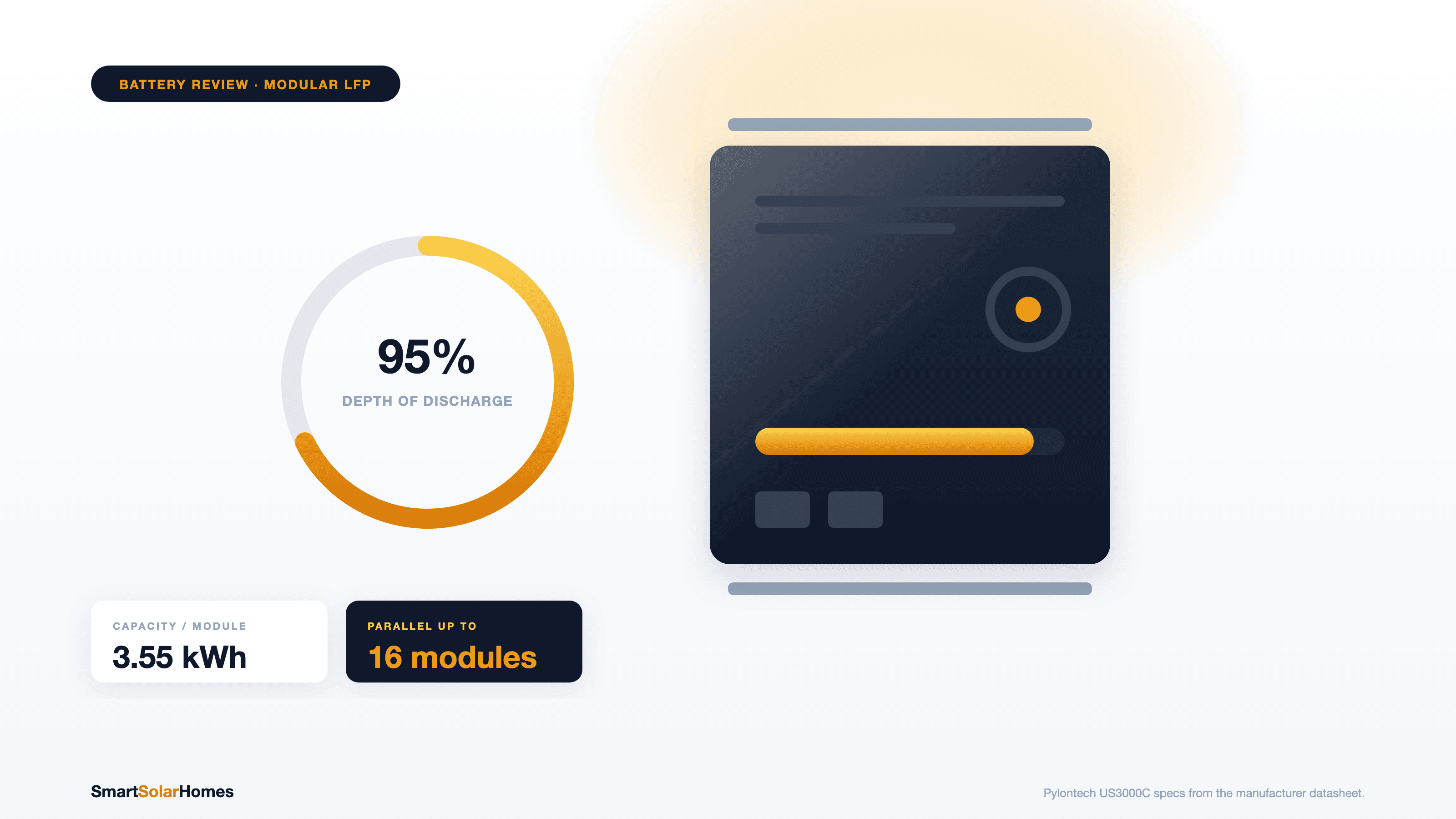
The Pylontech US3000C is a 3.55kWh lithium iron phosphate (LFP) battery module that sits in the middle of almost every "starter" home battery quote in the UK: small enough for a one-bed flat or a modest solar system, yet stackable up to 16 modules. This review works through Pylontech's own datasheet, this site's pricing, and the question that decides most purchases: is the smaller module ever better value than the larger Pylontech US5000?
Pylontech US3000C specs
Each US3000C stores 3.55kWh nominal (74Ah at 48V), of which 3.37kWh is usable at 95% depth of discharge. Figures below are from the US2000C/US3000C datasheet distributed by Effekta.
- Chemistry: lithium iron phosphate (LiFePO4), with a battery management system in every module
- Capacity: 74Ah / 3.55kWh rated; 70Ah / 3.37kWh usable at 95% DoD
- Current: 37A recommended charge/discharge, 74A maximum, with a 90A peak for 15 seconds
- Voltage: 48V nominal; 45.5–53.2V discharge range
- Size and weight: 442 × 420 × 132mm and 32kg per module
- Temperature: charge 0 to +50°C, discharge −10 to +50°C
- Communication: RS485 and CAN, so it can talk to compatible hybrid inverters
- Scaling: up to 16 modules per string and 6 strings in parallel
- Life: design life over 15 years at 25°C; certification TUV / CE / UN38.3
At the recommended 37A on a 48V bus, one module delivers roughly 1.8kW continuously (our calculation), and the datasheet quotes peaks of up to 4.3kW per module. That is plenty for a small home, but a single module will not run a kettle, oven and heat pump together. Stacking modules adds both capacity and power. Our battery sizing guide explains how to match modules to your usage.
Cycle life and warranty: read the small print
Pylontech's datasheet claims more than 8,000 cycles at 25°C (as of 1 February 2024) and a 7-year manufacturer warranty. This site's product listing instead shows 6,000 cycles and a 10-year warranty. Several UK and European retailers describe the same module as 7 years, extended to 10 years on registration, so treat 10 years as conditional until your installer confirms in writing that registration has been done and what the terms are. The cycle count is a laboratory figure at 25°C, not a promise of how long it lasts in an unheated garage. For real-world ageing see our solar battery lifespan guide.
Price in the UK
This site lists one US3000C at £815 ex VAT, which works out at about £242 per usable kWh (our calculation). The same arithmetic on the US5000 (£787.58 ex VAT, around 4.56kWh usable at 95% of its 4.8kWh nominal) gives roughly £173 per usable kWh. In other words, the smaller module costs more and stores less, which is the whole story of this review in one line. There is no inverter, cabling or installation in those prices. Residential batteries installed in Great Britain are zero-rated for VAT until 31 March 2027, reverting to 5% from 1 April 2027 (VAT Notice 708/6), so compare installed quotes rather than ex-VAT part prices. Our home battery installation guide covers typical installed costs.
The catch: it needs a compatible inverter
The US3000C is a bare 48V module with no inverter, so it only works with a hybrid inverter that supports Pylontech's RS485 or CAN protocol. Many popular brands do, but "supports Pylontech" varies by model and firmware, so ask your installer to confirm your exact inverter against the manufacturer's compatibility list before ordering. Our hybrid inverter buyer guide explains how battery compatibility works. The datasheet lists no ingress-protection rating, and the US5000 review notes IP20 for that sibling, so plan for a dry, ventilated indoor spot rather than an exposed outdoor wall.
US3000C vs US5000 vs Dyness DL5.0C
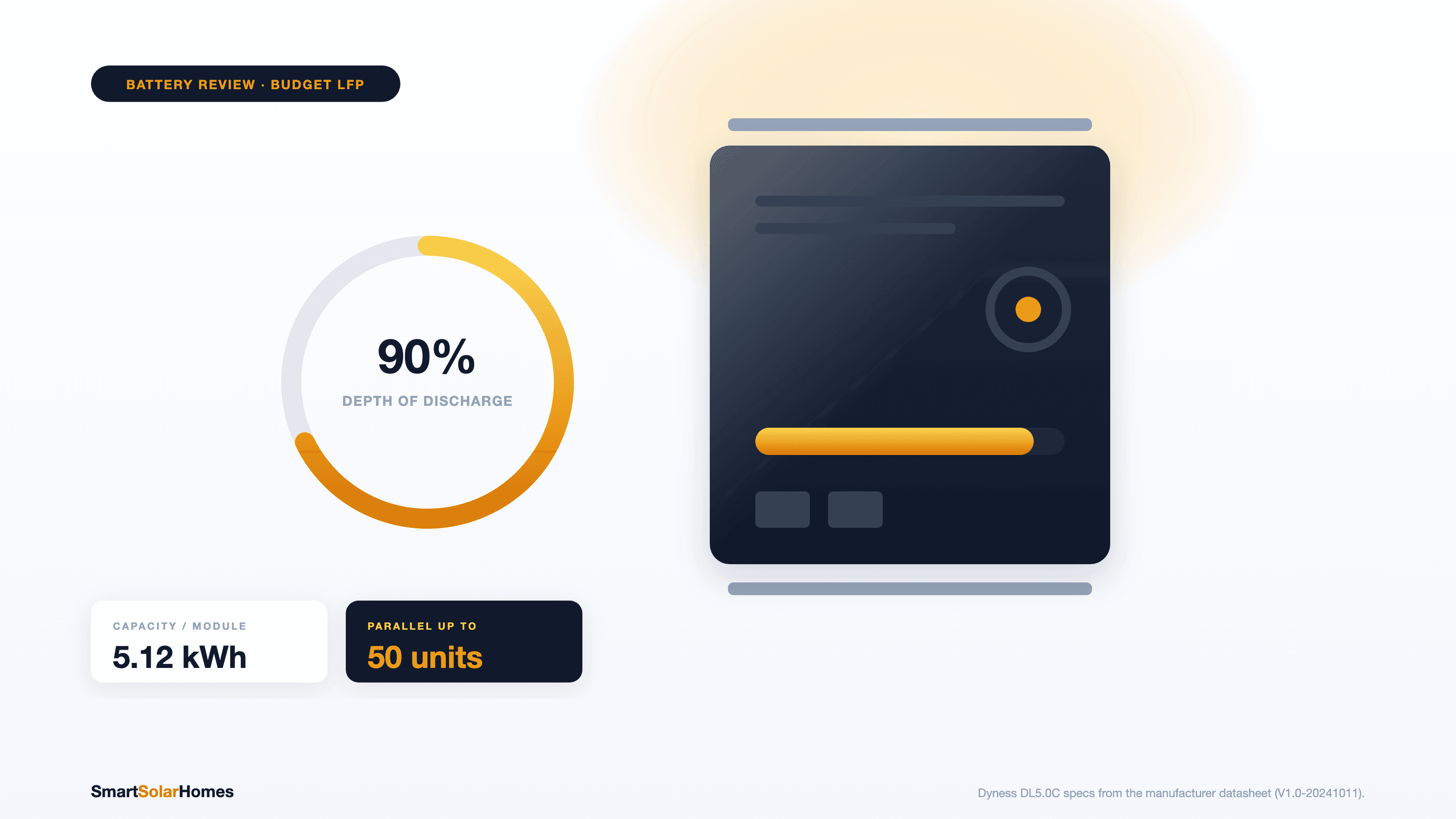
For a typical home using 8–12kWh a day, the US5000 is the better buy: more usable energy and a lower price per kWh from a single module. The Dyness DL5.0C is a cheaper 5.12kWh alternative with its own compatibility caveats. The US3000C wins in three narrower cases: a small home or flat using under about 7kWh a day (a suggestion, not a Pylontech figure), a tight space where the 132mm-deep, 32kg module is easier to fit and lift, and a top-up to an existing US3000C stack, where mixing module types is something to clear with the installer first.
Sizing: how many US3000C modules do you need?
Divide your target usable storage by 3.37kWh and round up. Two modules give about 6.7kWh usable, three about 10.1kWh and four about 13.5kWh (our calculation from the datasheet figure). Power scales too: because each module's recommended current is 37A, a two-module stack roughly doubles the continuous output of a single one. Check the maximum charge rate your inverter allows, because a single module at 37A recommended can limit how fast surplus solar is stored. If you expect to grow the system, allow wall space and a sensible cable route for extra modules now, since retrofitting a stack later is cheaper when the first install left room.
Who the Pylontech US3000C suits
It suits small homes, phased installs where you add modules as budget allows, and anyone extending an existing Pylontech stack. It is a weaker fit for larger households, where two US5000s will usually give more storage for the same money. For a wider shortlist, see our home battery storage guide.
FAQs
How much usable capacity does the Pylontech US3000C have?
How many Pylontech US3000C modules can be connected?
What warranty does the Pylontech US3000C have?
Is the Pylontech US3000C better than the US5000?
Does the Pylontech US3000C include an inverter?
Sources — verified 4 November 2026
- Pylontech (via Effekta), “Pylontech US2000C/US3000C datasheet” — cdn.enfsolar.com
- Quality Heating, “Pylontech US3000C 3.55kWh battery module listing (warranty terms)” — qualityheating.co.uk
- GOV.UK, “VAT on energy-saving materials and heating equipment (VAT Notice 708/6)” — www.gov.uk

About the author
Sepehr
Solar specialist & co-founder, Smart Solar Homes
Solar specialist and co-founder of Smart Solar Homes, which works with MCS-certified UK installer partners. I write all the guides and reviews here; the aim is straight-talking education the industry rarely provides.
Citing this page? Please use a dofollow link back to the original article — it helps us keep the data on this page accurate and up to date.
Browse Battery Storage on Smart Solar Homes


Want to compare these side by side? Use the compare tool →
Or browse all Battery Storage on Smart Solar Homes.
Related reading
More on battery storage from the editorial team.
Find installers near you
MCS-certified solar installers covering these areas.