Jinko Solar Panels Review UK: Tiger Neo 435W & Warranty
Written and reviewed by Sepehr. See our editorial policy.
Jinko Solar panels are among the most commonly quoted on UK roofs, and the Tiger Neo is the range you are most likely to see on an installer's paperwork. Jinko is a Chinese manufacturer, and this review looks at one specific, popular model, the all-black 435W Tiger Neo (JKM435N-54HL4R-B): what the datasheet actually says, how the warranty works in practice, and what to check before you accept it on a quote.
Is Jinko a good solar panel brand?
On reliability testing, Jinko's record is strong. In June 2026 the company announced that it had again earned a "Best Performer" (Top Performer) place in Kiwa PVEL's 2026 PV Module Reliability Scorecard, its twelfth year in a row. That is Jinko's own announcement, and the scorecard tests sample modules built to a particular bill of materials across thermal cycling, damp heat, mechanical stress, hail, PID, LID/LETID and power performance, so it supports the brand's general record rather than guaranteeing every panel on your roof. It is a better quality signal than the "Tier 1" label, which describes bankability rather than build quality; our Tier 1 vs Tier 2 guide explains the difference.
Jinko Tiger Neo 435W at a glance
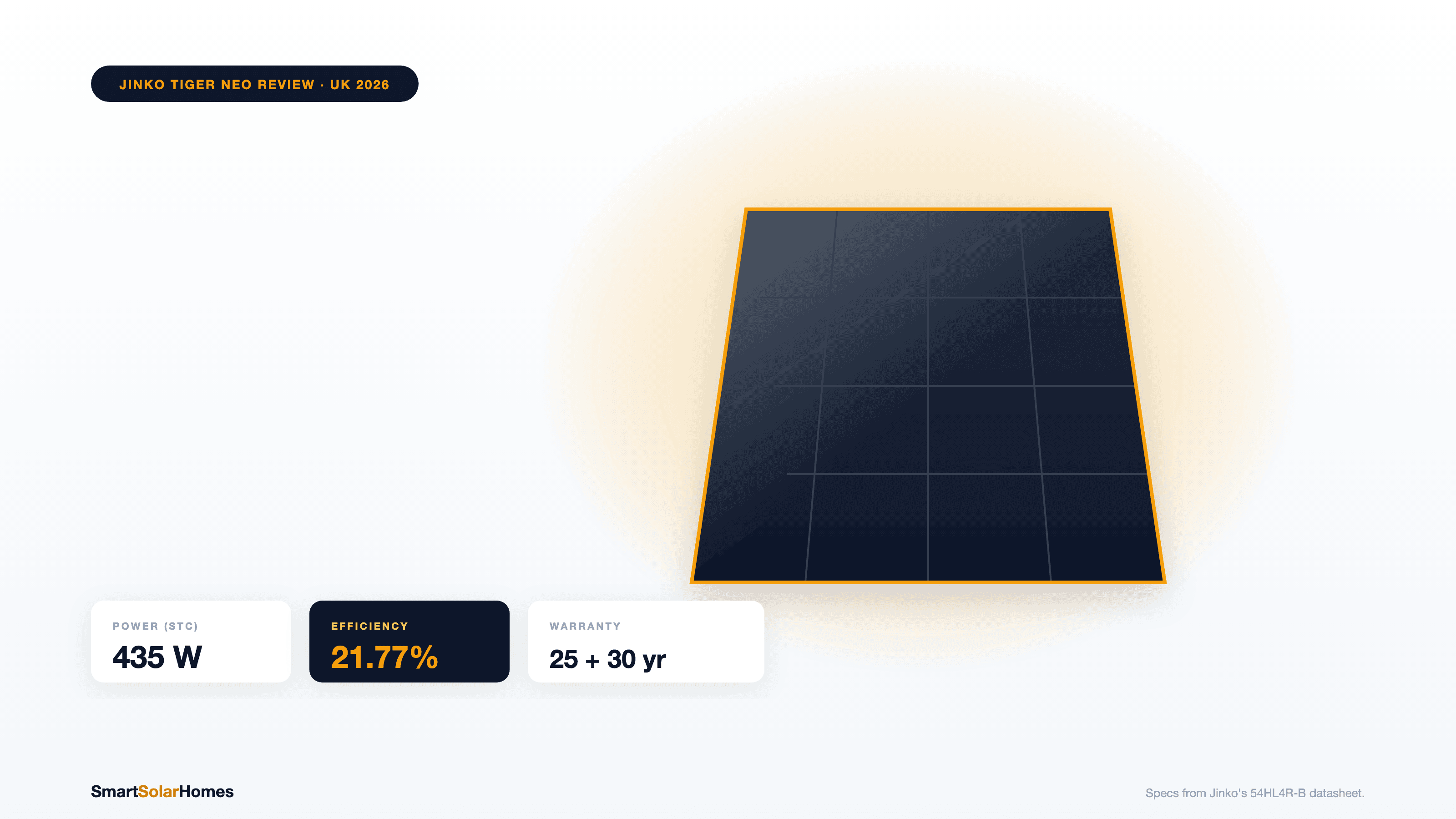
The Tiger Neo is Jinko's N-type TOPCon range. Figures below are from Jinko's 54HL4R-B datasheet (425–445W), using the 435W column:
- Power and efficiency: 435Wp at 21.77% module efficiency, with a 0 to +3% positive power tolerance.
- Construction: 108 N-type mono cells (6×18), 3.2mm anti-reflection tempered glass, anodised aluminium frame, all-black appearance.
- Size and weight: 1,762 × 1,134 × 30mm and 22kg, roughly 2m² per panel.
- Heat behaviour: temperature coefficient of Pmax of −0.29%/°C and a NOCT of 45±2°C.
- Loads and safety: certified for 4,000Pa wind and 6,000Pa snow load; IP68 junction box; 1,000V DC maximum system voltage.
The −0.29%/°C figure means output falls a little less in hot weather than on older P-type panels; our temperature coefficient guide explains what that means on a real roof. For the cell technology, see TOPCon vs PERC.
The 435W rating sits in a 1.998m² footprint, so eight panels give about 3.5kWp. On a tight roof, check the layout with your installer rather than counting watts per panel; our roof layout guide shows how.
Jinko warranty: what the paperwork says
The datasheet headline is 25-year product warranty and 30-year linear power warranty. Jinko's European Limited Warranty (revision SEU20220125) confirms both for the all-black 54HL4-B models: a 300-month (25-year) product warranty and a power guarantee of no more than 1% loss in year one and 0.4% a year after, leaving at least 87.4% of nominal output at year 30.
The fine print is where homeowners get caught:
- The clock may start before your install. Warranty start is the earlier of delivery or 180 days after the manufacture date on the serial number, so panels that sat in a warehouse have less than the full term left.
- Claims have a deadline. You must give written notice within 30 days of discovering a defect, with photographs, serial numbers and the warranty start date. E-mail alone is not valid notice under the document.
- Remedy is Jinko's choice. Jinko can repair, replace, or supply extra modules to make up lost power. It does not cover removal, reinstallation or consequential losses, so ask your installer what their own workmanship guarantee covers.
- Exclusions. Panels removed and re-installed in a different location, or damaged by lightning, electrical surges, flood, fire or vandalism, are excluded. Our surge protection guide and home insurance guide cover those gaps.
- Transfer. The warranty can be assigned in whole to a new owner with written notice to Jinko, which matters if you later sell a house with solar panels.
Because warranty terms vary by model and region, ask your installer for the warranty document that applies to the exact panel on your quote.
Price and MCS eligibility
Hardware prices vary widely by supplier and volume, and panels are a modest part of the total. Scaffolding, inverter, labour and any battery drive the bill; our solar panel cost guide covers installed costs. To be paid under the Smart Export Guarantee your system must be MCS-certified, and that applies to specific panel models, so ask your installer to confirm the exact Jinko model is on the MCS product database. See our MCS certificate guide.
How Jinko compares
Jinko is a mainstream, good-value choice rather than the premium end of the market. Back-contact panels such as those in our LONGi review reach higher efficiency, Trina and JA Solar compete closely on specifications and warranty. For the wider field, see solar panel manufacturers in the UK and the best solar panels UK ranking.
Our verdict
The Jinko Tiger Neo 435W is a well-tested, sensibly specified all-black N-type panel: 21.77% efficiency, a good temperature coefficient and a 30-year power guarantee. Pin down three things before signing: that the 25-year product warranty applies to your exact model, when the warranty clock starts, and that the model is MCS-listed. Compare quotes from an MCS-certified installer on warranty as carefully as on price.
Want a premium alternative with labour-inclusive cover? See our REC Alpha Pure-R review.
FAQs
Are Jinko solar panels good quality?
What warranty do Jinko Tiger Neo panels have?
How efficient is the Jinko Tiger Neo 435W?
When does a Jinko solar panel warranty start?
Where do I make a Jinko warranty claim?
Sources — verified 6 November 2026
- Jinko Solar, “Tiger Neo N-type 54HL4R-B 425-445W datasheet (JKM425-445N-54HL4R-B-F2-EN)” — jinkosolar.eu
- Jinko Solar, “Limited Warranty, Rev. SEU20220125-LINEAR for Europe (via Midsummer Wholesale)” — midsummerwholesale.co.uk
- Jinko Solar, “JinkoSolar wins Best Performer honor on PVEL's PV Module Reliability Scorecard for the twelfth consecutive year (4 June 2026)” — www.jinkosolar.com

About the author
Sepehr
Solar specialist & co-founder, Smart Solar Homes
Solar specialist and co-founder of Smart Solar Homes, which works with MCS-certified UK installer partners. I write all the guides and reviews here; the aim is straight-talking education the industry rarely provides.
Citing this page? Please use a dofollow link back to the original article — it helps us keep the data on this page accurate and up to date.
Browse Solar Panels on Smart Solar Homes


Want to compare these side by side? Use the compare tool →
Or browse all Solar Panels on Smart Solar Homes.
Related reading
More on solar panels from the editorial team.
Find installers near you
MCS-certified solar installers covering these areas.