Solar Panels on a Bungalow UK: Cost, Roof Space and Rules
Written and reviewed by Sepehr. See our editorial policy.
Solar panels on a bungalow are usually straightforward: the roof is low, the install is easier to access and the planning rules are the same as for any other house. What needs care is the roof itself, since bungalows often have shallow pitches, hipped ends and older roofing materials. This guide covers how much roof you need, what scaffolding adds, the planning limits in England and what to check before you accept a quote.
Are bungalows good for solar panels?
Generally yes, with two caveats. A single-storey home puts the whole roof within easier reach, and a bungalow often has a large roof footprint compared with the number of rooms underneath. That is a general pattern rather than a measured statistic, so measure your own roof rather than assuming it.
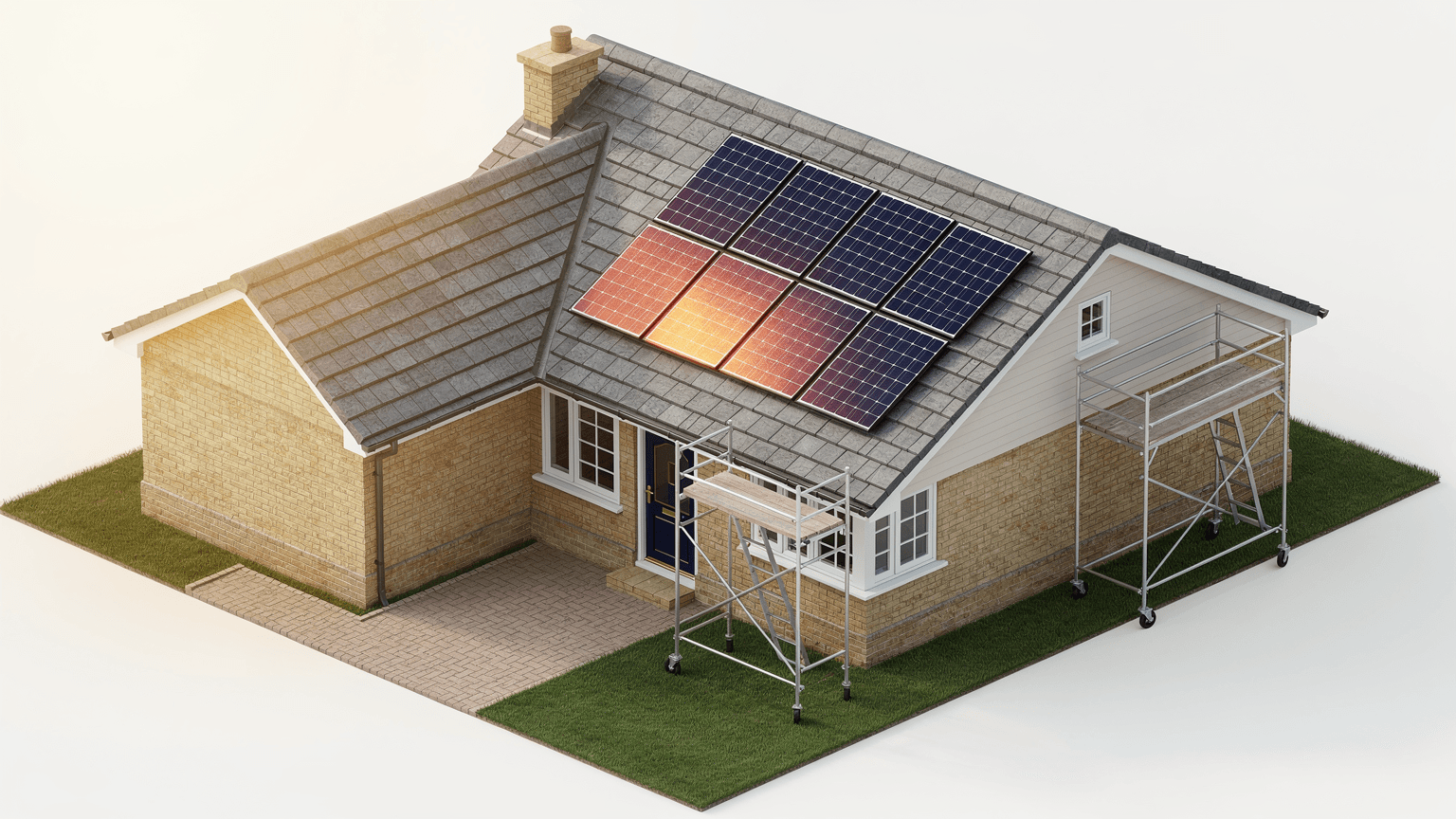
You still need scaffolding. A low roof does not remove the work-at-height risk. Sunsave notes that single-storey homes with pitched roofs still need scaffolding, and that ladders are viewed as inadequate for rooftop solar installation. Expect it to be priced into your quote, as covered below.
Older roofs need a proper look. Many bungalows were built decades ago, so the roof covering, the timbers and any asbestos cement sheeting (common on garages and extensions) matter more than the height. Our guide to preparing your roof for solar panels covers the checks.
How many panels fit on a bungalow roof?
Plan on roughly 2 m2 per panel. Sunsave assumes each panel measures around 2 m2 and describes a 10-panel, 4.5 kWp system as a typical fit for a three-bedroom home. Your installer will deduct room for roof edges, the chimney, vents and roof lights before counting panels.
- A modest bungalow with one usable slope often suits a system in the 2–4 kWp range. See our guides to a 3kW solar system and a 4kW solar system.
- A larger or L-shaped bungalow may take panels on two slopes, which can lift capacity or spread generation across the day.
- A tight roof can still work with higher-wattage panels. Our small roof solar guide explains the options.
Roof pitch and direction
Pitch matters, but less than shade. One UK installer guide puts the ideal pitch for year-round performance at 30–40 degrees. Bungalow roofs are often shallower than this, which can trim output slightly; your installer should model the exact figure for your roof rather than quote a generic number.
Direction is flexible. South is best, but east- and west-facing slopes are still viable; see how roof orientation affects solar output and what to do with a north-facing roof. Trees and neighbouring buildings can matter more on a low roof, because a bungalow sits lower than the things that shade it.
Cost and scaffolding
Typical system cost. The Energy Saving Trust gives around £6,100 for a typical 3.5 kWp system, fully installed. Battery storage is extra. Our solar panel cost guide breaks down current prices.
Scaffolding. Sunsave puts scaffolding for solar at roughly £700 to £2,000 depending on complexity, and says it is included in the quote. It lists height, access to both roof slopes, neighbouring buildings, lower roofs such as extensions, and complex shapes such as hipped roofs and dormers as cost drivers. Sunsave gives no bungalow-specific figure, so ask each installer to show scaffolding as a separate line.
VAT. Solar panels and batteries installed in a home in Great Britain are zero-rated for VAT until 31 March 2027, with the 5% rate applying from 1 April 2027. The timing rules are in our VAT explainer.
Do you need planning permission?
Usually not, in England. The Planning Portal sets these permitted development limits for panels on a house:
- Pitched roof: panels must not sit above the highest part of the roof (excluding the chimney) and must not project more than 200 mm from the roof slope.
- Flat roof: the equipment must be no more than 600 mm above the highest part of the roof, excluding the chimney.
- Conservation areas and World Heritage Sites: panels must not be fitted to a wall, balcony or roof enclosure that fronts a highway.
- Listed buildings: the permitted development rights do not apply to a building within the grounds of a listed building.
A 12-month transitional period runs until 27 August 2027, during which you can follow either the earlier rules or the new ones, according to the Planning Portal. Rules differ in Scotland, Wales and Northern Ireland, and the Planning Portal lists extra requirements for flat roofs on designated land. If you are in a conservation area, check with your council first; our conservation area guide goes into more detail.
Daytime use and batteries
Home use drives the saving. The Energy Saving Trust’s solar assumptions put the share of generation used in the home at around 30% without a battery. If someone is home during the day, that share can be higher, which is where a bungalow household with a daytime routine can do well. Adding a battery lifts self-consumption to around 65% on typical assumptions, but costs more upfront. Read whether solar batteries are worth it before deciding.
Checklist before you sign
- Get several MCS-certified quotes and compare scaffolding, panel count, inverter and warranty line by line.
- Ask about roof condition. If any part of the roof is asbestos cement, ask for a survey before work starts; the HSE asbestos pages explain the duties around it.
- Check the roof warranty position with your installer; see our guide to solar panels and your roof warranty.
- Confirm shading from trees, fences and neighbouring buildings, which hit low roofs hardest.
FAQs
Can you put solar panels on a bungalow?
How much does scaffolding cost for solar panels on a bungalow?
Do I need planning permission for solar panels on a bungalow?
How many solar panels can I fit on a bungalow roof?
Sources — verified 25 October 2026
- Planning Portal, “Planning permission: solar equipment mounted on a house or a block of flats or on a building” — www.planningportal.co.uk
- Sunsave, “Scaffolding for solar panels: costs and tips” — www.sunsave.energy
- Sunsave, “How much do solar panels cost in the UK?” — sunsave.energy
- Energy Saving Trust, “Solar panels: costs, savings and benefits explained” — energysavingtrust.org.uk
- Fuse Energy, “Is your roof suitable for solar panels?” — www.fuseenergy.com
- GOV.UK / HMRC, “VAT on energy-saving materials and heating equipment (Notice 708/6)” — www.gov.uk
- HSE, “Asbestos” — www.hse.gov.uk

About the author
Sepehr
Solar specialist & co-founder, Smart Solar Homes
Solar specialist and co-founder of Smart Solar Homes, which works with MCS-certified UK installer partners. I write all the guides and reviews here; the aim is straight-talking education the industry rarely provides.
Citing this page? Please use a dofollow link back to the original article — it helps us keep the data on this page accurate and up to date.
Browse Solar Panels on Smart Solar Homes


Want to compare these side by side? Use the compare tool →
Or browse all Solar Panels on Smart Solar Homes.
Related reading
More on solar panels from the editorial team.
Find installers near you
MCS-certified solar installers covering these areas.