Project EV Apex 7S Review UK: Specs, Solar & Verdict
Written and reviewed by Sepehr. See our editorial policy.
The Project EV Apex 7S is a 7.3kW single-phase home EV charger aimed at buyers who want smart features without a premium-brand price. This Project EV Apex 7S review works through the manufacturer's APEX-7.3 datasheet, one independent UK review and this site's product data to cover the specs, the Pro Earth installation saving, the solar and smart-tariff caveats, and who should (and should not) buy it.
Project EV Apex 7S specs
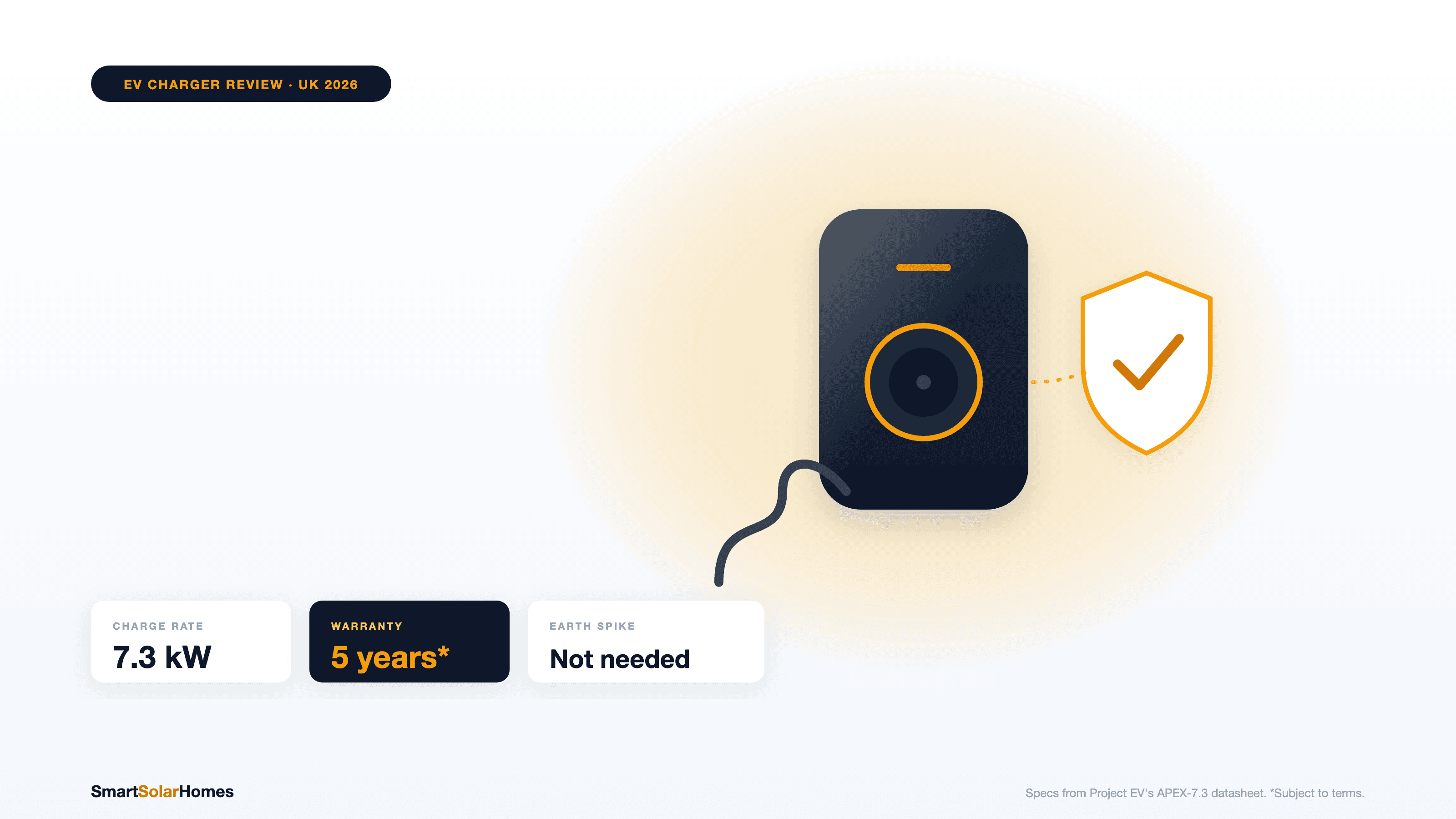
The Apex 7S is the untethered version: a Type 2 socket delivering up to 7.3kW (32A, 230V single-phase), with a 5m-cable tethered sibling called the APEX-7S-T. Figures below are from Project EV's own datasheet.
- Output: 7.3kW rated, 32A maximum, 230Vac ±20%, 50/60Hz
- Connector: Type 2 socket (untethered); the APEX-7S-T has a 5m Type 2 cable
- Size and weight: 320 × 190 × 144mm and 2.4kg (untethered); the tethered unit is 130mm deep and 4.1kg
- Protection: IP65 (socket IP54), IK08, wall or post mounting, operating range −30°C to 50°C
- Connectivity: Wi-Fi (range up to 30m depending on surroundings) and Bluetooth; 4G only on the separate APEX-7S-4G model; OCPP 1.6 JSON, with OCPP 2.0.1 listed as optional
- Access control: Mifare RFID reader, plug and play, or app start
- Metering: a pre-configured MID-approved meter, with a CT clamp and meter included
- Certification: CE and UKCA, to EN/IEC 61851-1:2019 and 61851-21-2:2021
- Warranty: five years, which Project EV says is subject to terms and conditions
Project EV does not publish a price on its datasheet. Our product data lists the unit at £330 ex VAT; one UK installer review puts it at roughly £550–£659 without installation, so retail prices clearly vary by version and seller. Get a written, itemised installation quote and check current EV charger grant rules before assuming any support applies.
Pro Earth: the installation saving
Project EV says the built-in Pro Earth PEN fault protection removes the need for an earth spike. The datasheet also lists an internal residual current device that detects AC 30mA and DC 6mA faults, so a separate DC-fault device is not normally needed either. On a PME (TN-C-S) supply that can mean less groundwork, which is where much of a budget charger's saving comes from. Your installer still has to confirm the supply type and sign off the installation, so treat it as a likely saving, not a guaranteed one. Our EV charger installation guide covers what a full install involves.
Does the Apex 7S work with solar panels?
Project EV advertises it as fully solar compatible, with a CT clamp included in the box. Its datasheet and website describe an "Intelligent Solar" feature and a solar charging mode in the app, but neither publishes how it behaves: there is no stated minimum charge rate, and no statement of how it handles a cloudy day with only 1–2kW spare. Project EV's site also says solar compatibility applies to single-gun AC models only, which includes this one.
In practice, treat it as a capable charger with a solar mode rather than a solar-first design. If most of your charging will come from surplus generation, compare it with chargers built around diversion in our best EV charger for solar panels guide, or read the myenergi Zappi review.
Smart tariffs and the app: the weak spots
The independent We Power Your Car review (page updated November 2026) is the clearest caution. It says the Apex 7S is not directly compatible with Intelligent Octopus Go, E.ON Smart Drive, EDF GoElectric or OVO Charge Anytime, and that the app was rated about 1.5 stars on both app stores when it was written. It calls the charger "decent, basic" when the app works and says better chargers exist. Compatibility lists change, so check with your supplier before buying, and see our best EV charging tariff guide if a smart tariff matters to you. The Apex's own scheduling and off-peak charging options work through its app rather than your supplier's.
Smart charge point rules
Home chargers sold in Great Britain must meet the Electric Vehicles (Smart Charge Points) Regulations 2021, which require smart functionality such as scheduling. The Apex has scheduling and app control, but this review did not find a published statement of compliance in the datasheet, so ask your installer or supplier to confirm it for the exact model. For what untethered means day to day, see EV charger speed and tethering explained.
Pros and cons
Strengths: low upfront price; Pro Earth and internal DC fault protection can cut installation cost; five-year warranty; RFID, OCPP 1.6 and a pre-configured MID meter are unusual at this price; IP65 and IK08 for outdoor use; dynamic load balancing.
Weaknesses: reported weak app experience; no direct compatibility with major smart EV tariffs; solar behaviour not documented; plainer, dated styling; 4G needs a different model.
Who should buy the Project EV Apex 7S?
It suits cost-focused households on a standard tariff that want a sturdy, no-frills 7.3kW charger, and landlords or small sites that value RFID and OCPP. It is a weaker fit for anyone chasing Intelligent Octopus Go rates or serious solar diversion; for those, compare the Ohme ePod, the Growatt THOR or our best home EV charger shortlist. Whichever you choose, use a qualified installer.
FAQs
Is the Project EV Apex 7S a good EV charger?
Does the Project EV Apex 7S need an earth spike?
Is the Project EV Apex 7S compatible with Intelligent Octopus Go?
Does the Project EV Apex 7S work with solar panels?
What is the difference between the APEX-7S and APEX-7S-T?
Sources — verified 11 November 2026
- Project EV, “APEX-7.3 Fast AC Single Outlet 7.3kW Tethered & Untethered Chargers: Technical Specifications (Datasheet V23)” — www.projectev.co.uk
- We Power Your Car, “Project EV Charger Review: Project EV Apex 7S, tested” — wepoweryourcar.com
- Project EV, “Project EV: AC and DC chargers (solar, load balancing, Pro Earth notes)” — www.projectev.co.uk
- legislation.gov.uk, “The Electric Vehicles (Smart Charge Points) Regulations 2021” — www.legislation.gov.uk

About the author
Sepehr
Solar specialist & co-founder, Smart Solar Homes
Solar specialist and co-founder of Smart Solar Homes, which works with MCS-certified UK installer partners. I write all the guides and reviews here; the aim is straight-talking education the industry rarely provides.
Citing this page? Please use a dofollow link back to the original article — it helps us keep the data on this page accurate and up to date.
Browse EV Chargers on Smart Solar Homes


Want to compare these side by side? Use the compare tool →
Or browse all EV Chargers on Smart Solar Homes.
Related reading
More on ev chargers from the editorial team.
Find installers near you
MCS-certified solar installers covering these areas.