Fronius Symo 6.0-3-M Review UK: 6kW Three-Phase Inverter
Written and reviewed by Sepehr. See our editorial policy.
The Fronius Symo 6.0-3-M is a 6kW three-phase string inverter with two MPP trackers, a built-in data logger and a reputation for flexible roof layouts. It turns up on UK quotes for larger homes with a three-phase supply, and on older systems where a replacement is being sized. This review works only from Fronius's own Symo datasheet (the 5.0 to 8.2-3-M table), so every figure below is traceable, and it flags what the datasheet does not tell you.
Fronius Symo 6.0-3-M at a glance
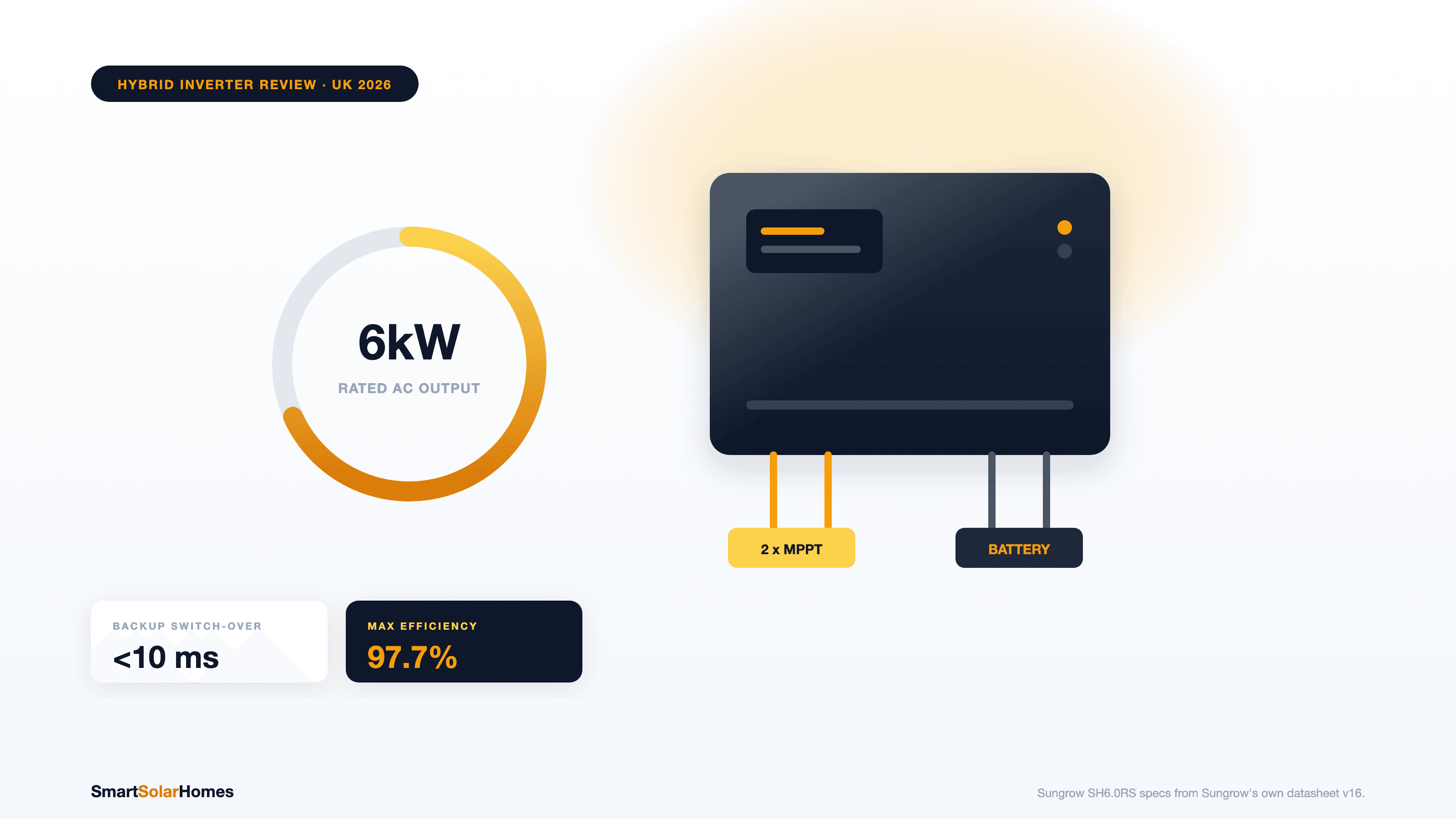
The Symo is a transformerless, three-phase design. Fronius's datasheet lists these values for the 6.0-3-M:
- AC output: 6,000W nominal and 6,000VA maximum, 8.7A per phase, onto a 3~NPE 400V / 230V grid connection at 50Hz.
- DC input: up to 12.0kWpeak of panels, 150V minimum input and 200V feed-in start voltage, 1,000V maximum.
- MPP trackers: two, each with a 195–800V MPP voltage range, 16A maximum input current and 24A maximum array short-circuit current, with 2+2 DC connections.
- Efficiency: 98.0% maximum, 97.5% European efficiency, and MPP adaptation efficiency above 99.9%.
- Build: 645 × 431 × 204mm, 19.9kg, IP65, regulated air cooling, protection class I, with indoor and outdoor installation allowed and an ambient range of −25 to +60°C.
- Standby draw: under 1W at night.
Who the Symo 6.0-3-M suits
Three-phase homes. The Symo is three-phase only, so it is for properties with a three-phase supply. Most UK homes are single-phase, and a single-phase house should be looking at single-phase inverters instead. Our best solar inverter guide covers that choice.
Split or awkward roofs. Two MPP trackers let you put two separate strings, such as an east and a west roof, on independent inputs. With a 195–800V window and 12kWp of permitted panel power, a 6kW inverter can be paired with a larger array. Fronius markets this as its SuperFlex Design. If you have more than two orientations, or heavy shading, compare against optimisers or microinverters in our string vs microinverter vs optimiser guide.
Monitoring without extras. The datasheet lists WLAN and Ethernet, Fronius Solar.web, Modbus TCP SunSpec and the Fronius Solar API as standard, with the data logger and web server included. It also has an S0-meter interface and a ripple-control receiver interface (6 inputs, 4 digital in/out).
What the datasheet does not tell you
It is not a battery inverter. The datasheet describes a grid-tied string inverter with no battery port. If you want storage, you would add an AC-coupled battery or choose a hybrid model; see our hybrid inverter buyer guide.
The datasheet is old. The PDF we used carries a 2016 creation date in its file metadata. That tells you the Symo is an established design, not a current product launch. Fronius's datasheet itself says the availability of its inverters should be checked for your country, so confirm with the installer that the exact model is in stock, supported and covered.
The grid code listing predates current rules. The compliance list on the datasheet includes G83/2, the older small-generator standard, alongside others such as VDE, IEC 62109 and NRS 097. A new UK installation is notified or applied for under the current ENA engineering recommendations: G98 up to 3.68kW per phase (11.04kW on three phases) is notify-after, while larger systems need G99 approval before installation. Ask your installer for the inverter's current G98 or G99 compliance documentation rather than relying on the datasheet; our DNO application guide explains the process.
No warranty or price in the datasheet. We could not verify a manufacturer warranty length from Fronius's own documents, and warranty terms vary by installer and region, so get the period, the claims route and who handles replacement in writing before you sign.
Symo vs other inverters you will be quoted
If your quote offers optimisers, our SolarEdge inverter review covers that alternative, where every panel has its own module-level electronics. The Symo's approach is plain string-level MPP tracking: simpler hardware, but one shaded panel can drag down its whole string. Its 98.0% peak efficiency is good but, as with any inverter, real-world yield depends mostly on layout, shading and sizing.
Verdict
The Symo 6.0-3-M is a capable, well-documented three-phase string inverter: two trackers, strong efficiency figures, IP65 build and monitoring built in. It is a sensible fit for a three-phase home with two roof directions and no battery plans. Its main weaknesses are what is missing: no battery support, an older datasheet and no warranty details in the document. Before you accept a quote, confirm availability, current G98/G99 compliance and the warranty in writing.
FAQs
Is the Fronius Symo 6.0-3-M three-phase?
How many MPP trackers does the Fronius Symo 6.0-3-M have?
How efficient is the Fronius Symo 6.0-3-M?
Can the Fronius Symo 6.0-3-M work with a battery?
Does a 6kW three-phase inverter need DNO approval?
Sources — verified 8 November 2026
- Fronius International, “Fronius Symo datasheet (technical data for Symo 3.0-3-S to 8.2-3-M, via Midsummer Wholesale)” — midsummer.ie
- Energy Networks Association, “Engineering Recommendation G98, Issue 2 (March 2025)” — dcode.org.uk
- Energy Networks Association, “Engineering Recommendation G99, Issue 2 (March 2025)” — dcode.org.uk

About the author
Sepehr
Solar specialist & co-founder, Smart Solar Homes
Solar specialist and co-founder of Smart Solar Homes, which works with MCS-certified UK installer partners. I write all the guides and reviews here; the aim is straight-talking education the industry rarely provides.
Citing this page? Please use a dofollow link back to the original article — it helps us keep the data on this page accurate and up to date.
Browse Inverters on Smart Solar Homes


Want to compare these side by side? Use the compare tool →
Or browse all Inverters on Smart Solar Homes.
Related reading
More on inverters from the editorial team.
Find installers near you
MCS-certified solar installers covering these areas.