Budget 2026 Energy Changes for Solar Homes

Written and reviewed by Sepehr. See our editorial policy.
Chancellor John Healey delivered the first Budget since Andy Burnham became prime minister on 28 October 2026, and the energy measures are mostly about bills. There is a £100 payment for up to 20 million households, the 0% VAT rate on electricity is extended to July 2027, and gas standing charges are to be abolished. On home upgrades, the Treasury's Budget document keeps the Boiler Upgrade Scheme funded but takes £1 billion of capital grant out of the Warm Homes Plan. Here is each change, checked against the Treasury's published document, and what it means for solar, battery and heat pump owners.
The £100 household energy payment
Households in council tax bands A to D in England will get a £100 Household Energy Payment, paid directly into bank accounts from January 2027. The Treasury costs it at £2.6bn and says it supports up to 20 million households through the Council Tax system. Scotland, Wales and Northern Ireland receive their share of the funding through the Barnett formula and are expected to provide similar support. The Treasury says around 80% of households in England will gain from it.
It is a one-off payment, not a change to the price cap, and it does not depend on how much energy you use or whether you generate your own. To help fund it, the Bank Corporation Tax Surcharge rises from 3% to 6% for 15 months, from 1 January 2027 to 31 March 2028.
VAT on electricity stays at 0% until July 2027
The 0% rate of VAT on household electricity in Great Britain is extended by three months, to July 2027. It had been due to end in March 2027, and it was not made permanent. The Treasury expects the extension to take around £50 off the annual Ofgem price cap in April 2027. Northern Ireland gets comparable support through funding to the Executive.
The zero rate began on 1 October 2026; our explainer on VAT on electricity bills covers what it does and does not change, including for solar owners. Because it applies to the electricity you buy from the grid, it still matters if you have panels and a battery but import power in winter. For how the bill rate interacts with the cap, see the energy price cap explained.
Gas standing charges to be abolished
The government has asked Ofgem to abolish gas standing charges, aiming for delivery by the end of 2027 or as soon as possible after. The Treasury says they currently average £108 a year for a typical household. Suppliers will recover those costs through gas unit rates instead, so the money moves rather than disappears. The Budget document says a “significant majority” will benefit but some households may be less able to make the most of the change, and promises targeted mitigation. It also commits to reforming electricity standing charges, with details next year.
BBC News quoted Paul Johnson, the former head of the Institute for Fiscal Studies, saying the change will result in “some people gaining and some people losing”, and economics editor Faisal Islam describing it as a redistribution from high users to low users that costs the Exchequer nothing, with an incentive to shift from gas to electricity.
For anyone weighing a heat pump, that shift is the relevant part. A dearer gas unit rate narrows the running-cost gap with a boiler, though the size of the effect depends on how much moves into the unit rate, and that is not yet known. Our heat pump vs gas boiler comparison and heat pump running costs guide use current prices and will need revisiting once Ofgem sets the new structure.
Heating oil tariffs suspended
The government is temporarily suspending import tariffs on kerosene heating oil for two years, until December 2028, citing households that rely on it, including many in rural areas and Northern Ireland. The document gives no saving figure for households.
Boiler Upgrade Scheme maintained, Warm Homes Plan trimmed
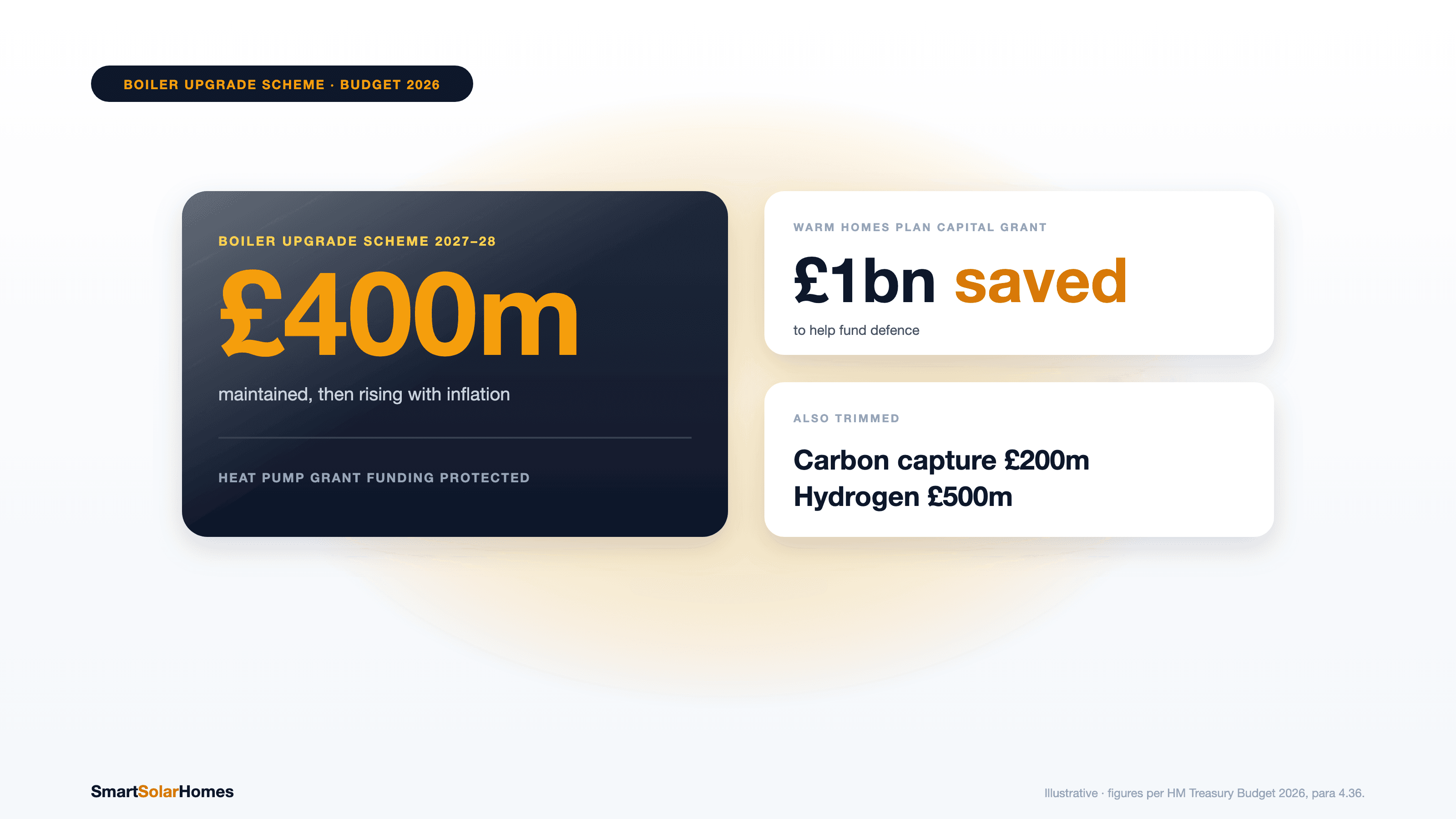
The Treasury says it will “maintain the Boiler Upgrade Scheme at current funding levels of £400 million in 2027‑28 and rising broadly in line with inflation thereafter”. That answers the October reports that ministers were looking to cut the scheme to help fund defence. The scheme is not being cut in this Budget; see our full analysis in Boiler Upgrade Scheme safe in the Budget.
The same paragraph shows where the defence contribution does come from. The government will “save £1 billion capital grant from the Warm Homes Plan”, alongside savings from carbon capture and hydrogen projects. It says the majority of Warm Homes Plan funding for low-income households and social housing, delivered by mayors and councils, is protected, and that the Warm Homes Loan Scheme has launched. Our Warm Homes Plan guide and Warm Homes Loan Scheme explainer describe the programme as it stood before this change.
What the document does not change for solar
We searched the Budget document and found no change to the 0% VAT rate on solar panels and batteries. HMRC's notice still has it reverting to 5% from 1 April 2027; see VAT on solar panels rises to 5% in April 2027. Do not confuse that with the electricity bill VAT cut above, which is a separate measure. The Budget document also does not set out grant levels for the Boiler Upgrade Scheme, so the current £7,500 and £9,000 rates are unchanged by it.
What it means for solar, battery and heat pump owners
- Solar and battery owners: the electricity VAT cut and the £100 payment apply regardless of generation. They do not change what you earn from exports.
- Heat pump owners and buyers: the Boiler Upgrade Scheme funding is protected, and the gas standing charge change is the one to watch for running-cost comparisons.
- Anyone planning an install: nothing in the Budget moves the 31 March 2027 VAT deadline for solar and batteries, so the timing advice in our VAT guide still stands.
FAQs
Who gets the £100 energy payment in the Budget?
How long is the electricity VAT cut extended for?
When will gas standing charges be abolished?
Is the Boiler Upgrade Scheme being cut in the Budget?
Sources — verified 28 October 2026
- HM Treasury, “Budget 2026 (HC 726), paragraphs 3.4, 3.5, 3.9 and 4.36” — assets.publishing.service.gov.uk
- GOV.UK, “Budget 2026 document” — www.gov.uk
- BBC News, “Budget 2026: Key points from John Healey's speech” — www.bbc.co.uk
- BBC News, “Budget 2026 live: Healey announces £100 energy payment for 20 million households” — www.bbc.co.uk
- GOV.UK / HMRC, “VAT on energy-saving materials and heating equipment (Notice 708/6)” — www.gov.uk

About the author
Sepehr
Solar specialist & co-founder, Smart Solar Homes
Solar specialist and co-founder of Smart Solar Homes, which works with MCS-certified UK installer partners. I write all the guides and reviews here; the aim is straight-talking education the industry rarely provides.
Citing this page? Please use a dofollow link back to the original article — it helps us keep the data on this page accurate and up to date.
Browse Solar Panels on Smart Solar Homes


Want to compare these side by side? Use the compare tool →
Or browse all Solar Panels on Smart Solar Homes.
Related reading
More on solar panels from the editorial team.


Find installers near you
MCS-certified solar installers covering these areas.